Material name: Red Rods – Montessori Red Rods
Area: Sensorial
Purpose & developmental benefits:
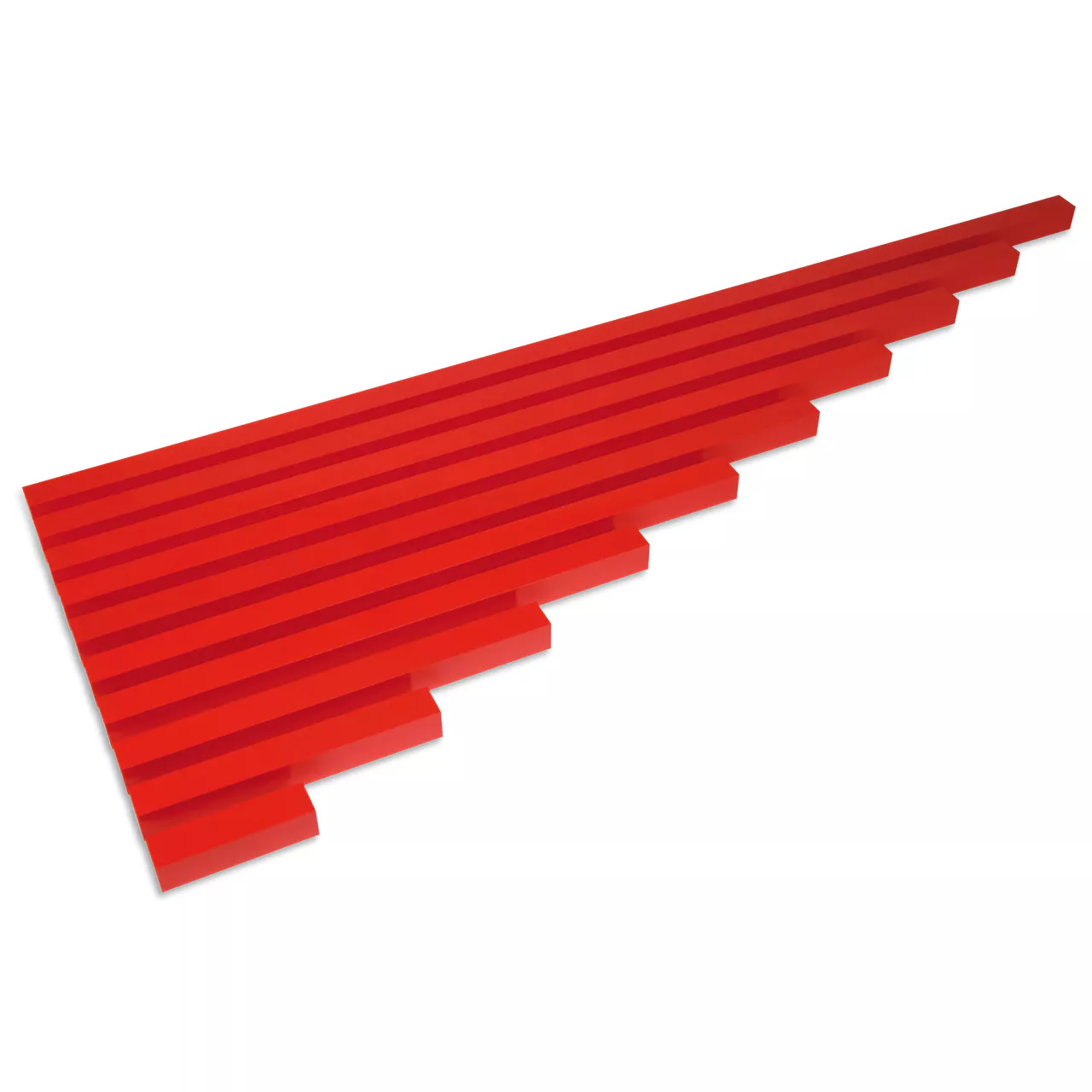
The Red Rods help children recognize and distinguish length by arranging rods from shortest to longest. With their uniform red color, the material eliminates visual distractions related to color, allowing the child to focus entirely on a single concept: length. Through hands-on work, children develop an inner sense of order, comparative thinking, and sustained concentration.
Skills children develop:
-
Recognize differences in length (short–long)
-
Arrange objects in increasing or decreasing order of length
-
Develop hand–eye coordination, gross motor, and fine motor skills when carrying and placing the rods
-
Strengthen observation, comparison, and estimation skills
-
Build concentration, persistence, and sequential work habits
-
Enrich descriptive language: longest, shortest, longer than, shorter than
-
Lay a foundation for measurement concepts (length comparison and later units of measure)
Recommended age: 2.5–6 years old (Casa)
One of the earliest sensorial materials introduced in the Montessori environment.
Materials & components:
-
A set of 10 wooden rods with gradually increasing lengths according to Montessori standards (typically from 10 cm to 100 cm)
-
Solid red color with no variation
-
Natural wood with smooth surfaces and rounded edges for safety
-
Large size suitable for floor work
Control of error:
When arranged incorrectly, the sequence will not appear smooth or orderly, making it easy for the child to recognize and correct the mistake independently.
Use in the classroom / at home:
Used on a mat in the Sensorial area. Children learn to carry each rod with both hands, arrange them from longest to shortest or shortest to longest, and then check their work visually and by touch. Extensions may include comparison games (e.g., finding the second longest rod or identifying which rod is shorter) and language work through the three-period lesson. At home, provide a long, open workspace, place the rods on a low shelf, and avoid mixing them with similarly sized materials so the child can focus on length as the primary variable.