Material Name: Mystery Bag – Montessori Mystery Bag
Curriculum Area: Sensorial & Language
Purpose & Developmental Benefits
The Mystery Bag helps children develop the tactile sense and mental imagery through touching, guessing, and naming objects without using vision. By identifying objects solely through hand exploration, children build abstraction skills, tactile memory, and expressive language. This material naturally connects sensory experience, thinking, and language development.
Skills Developed
-
Recognizing and naming objects through touch alone, without visual input
-
Discriminating object characteristics such as shape, size, material, and surface texture
-
Developing tactile memory and spatial imagination
-
Expanding descriptive language (smooth/rough, round/flat, long/short, heavy/light, etc.)
-
Strengthening concentration, perseverance, and purposeful work
-
Indirect preparation for 3D geometry, science concepts, and reasoning skills
Recommended Age
Material & Construction
-
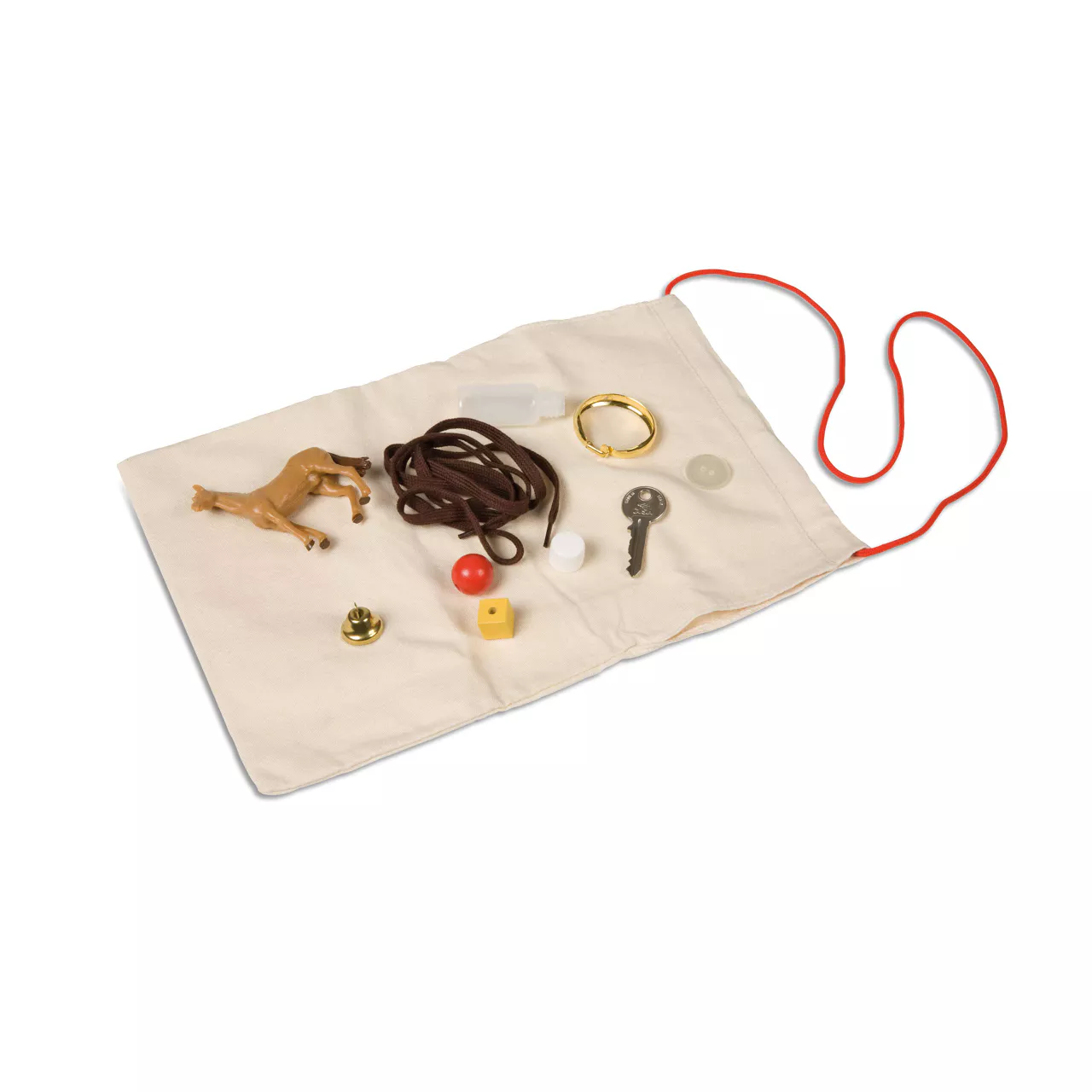
A soft, closed fabric bag with an opening wide enough for a child’s hand but preventing visual access to the contents
-
May be paired with a set of small themed objects for identification (familiar objects, natural materials, geometric forms, etc.)
-
Typically plain-colored with minimal decoration to avoid distraction
-
Child-safe and appropriately sized
-
Contents can be easily changed to increase or decrease difficulty
Classroom & Home Use
-
Place 3–6 familiar objects inside the bag
-
The child inserts a hand, explores each object by touch, guesses and names it, then removes it to check
-
Extensions include matching identical objects, sorting by material or shape, or “find-by-description” games (e.g., “Find something round”)
-
Language work may include describing characteristics or creating short stories
At home, everyday household or natural objects (spoon, keys, shells, etc.) can be used to keep the activity fresh, meaningful, and closely connected to the child’s environment.