Material Name: Geometry Cabinet – Montessori Geometry Cabinet
Curriculum Area: Sensorial & Mathematics (Geometry)
Purpose & Developmental Benefits
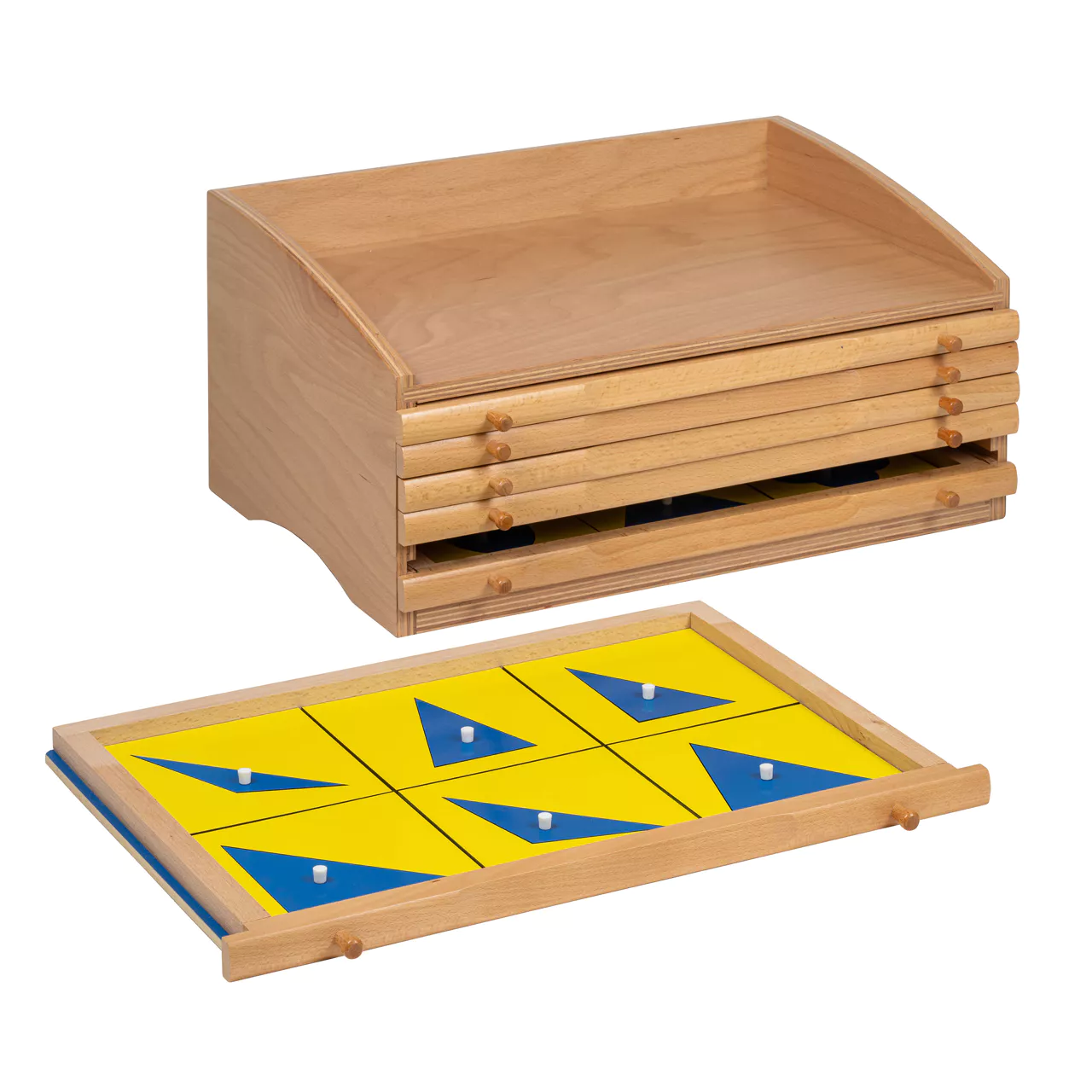
The Geometry Cabinet helps children become familiar with and recognize plane geometric shapes through the activity of removing and replacing geometric insets into their corresponding frames. Children learn through both tactile and visual exploration, allowing them to form precise geometric concepts, refine their ability to discriminate shapes, curves, and straight edges, and naturally expand their geometric vocabulary.
Skills Developed
-
Recognizing and distinguishing plane geometric shapes from basic to more advanced forms
-
Tactile exploration of shapes through finger tracing (sides, angles, curves)
-
Classifying shapes into families (triangles, quadrilaterals, polygons, curved figures, etc.)
-
Developing hand–eye coordination and fine motor control through lifting knobs and precise placement
-
Increasing concentration, sequential work habits, and self-correction through built-in control of error
-
Expanding geometric language: names of shapes, number of sides and angles, convex/concave, curved/straight
-
Direct preparation for elementary geometry concepts (perimeter, area, shape analysis)
Recommended Age
-
3–6 years (Casa): Introduction and foundational work
-
6–9 years: Review, concept extension, and more advanced geometry work
Material & Construction
-
Wooden cabinet with multiple drawers, made according to Montessori standards
-
Each drawer contains geometric frames and removable insets (circle, square, triangle, polygons, curved shapes, etc.)
-
Shapes typically follow a progression:
-
Basic shapes: circle, square, triangle, rectangle, oval
-
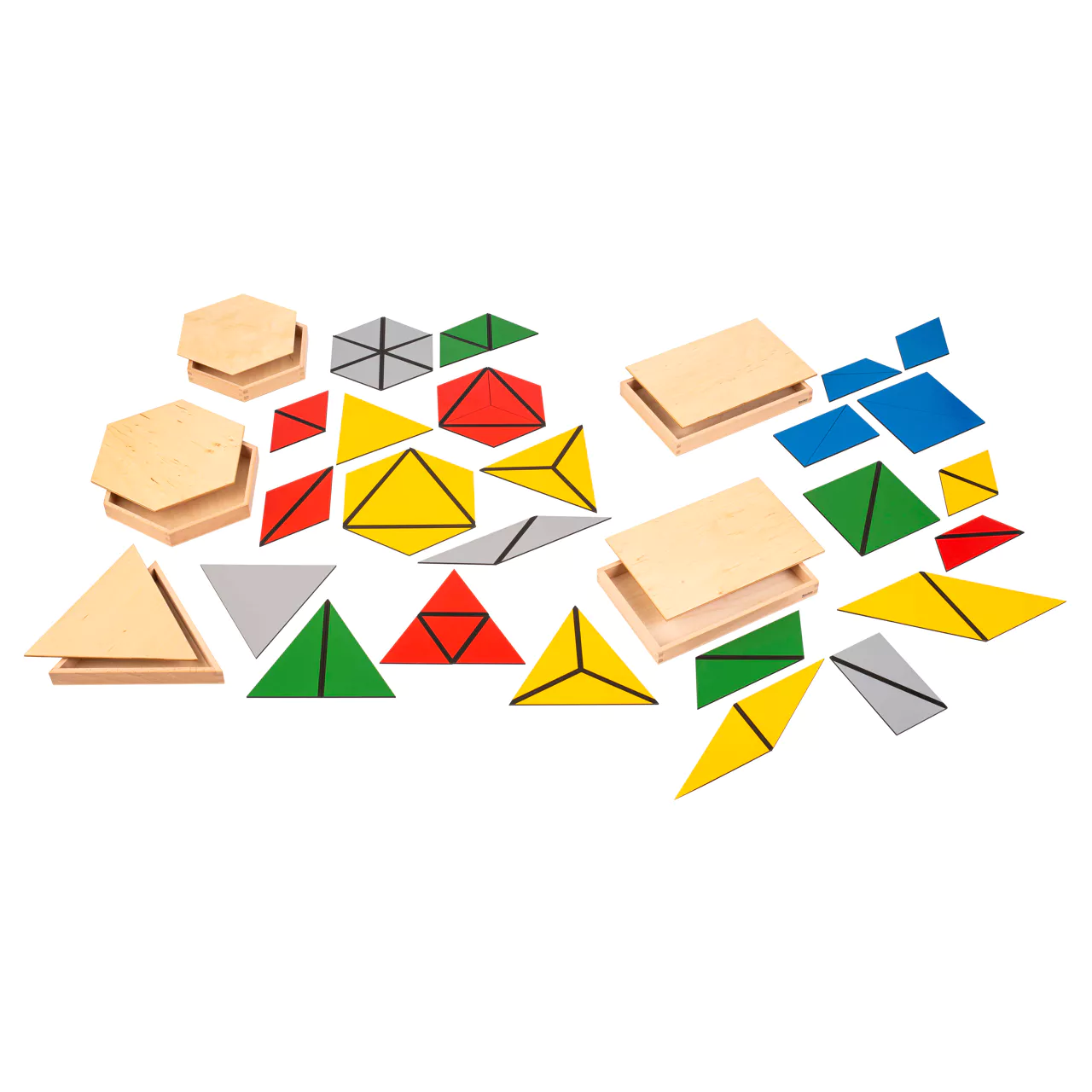
Advanced triangles, quadrilaterals, polygons, and curved figures
-
Made of natural wood with smooth surfaces and rounded edges for safety
-
Small knobs support precise fine motor movement; tightly fitted frames provide natural control of error when shapes are placed incorrectly
Recommended Companion Materials
Demonstration Tray (Geometry Tray):
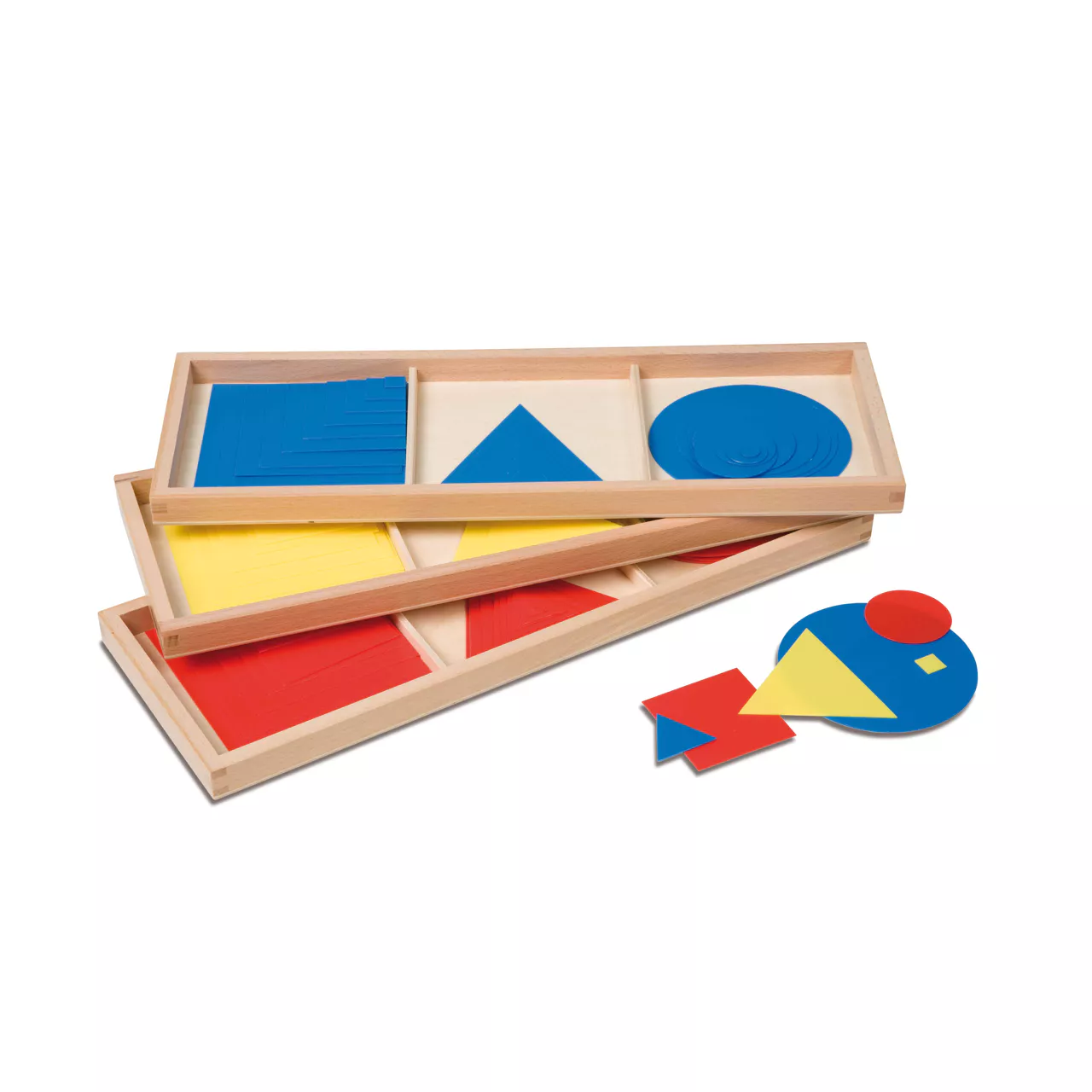
Used to place the geometric insets after removing them from the frames, allowing the child to clearly observe each shape and trace its edges (sides, angles, curves) with their fingers. The tray supports comparison of similarities and differences between shapes and is ideal for the Three-Period Lesson, helping children move from sensorial experience to accurate geometric language.
Geometric Form Cards for the Demonstration Tray:
A set of cards corresponding to the geometric insets, usually presented in a sequence of filled shapes, outlined shapes, and label cards. Matching the inset to the card and the name strengthens geometric understanding, develops observation and classification skills, expands vocabulary, and prepares the child for abstract geometric thinking at the elementary level.
Classroom & Home Use
Used in the Sensorial or Mathematics/Geometry area. Children work progressively from easier to more complex drawers: selecting a tray, choosing one or two frames, removing the insets, tracing the edges with two fingers, and returning each shape to its correct frame.
The work can be extended by using the Demonstration Tray and Geometric Form Cards (or Geometry Cards) to match insets with filled or outlined cards and to conduct the Three-Period Lesson for naming shapes.
At home, the cabinet should be placed on a low, fixed shelf. Children are encouraged to work with one drawer at a time to avoid overload and to support concentration.