Material Name: Rough Tablets – Montessori Rough Tablets
Curriculum Area: Sensorial (Tactile Sense)
Purpose & Developmental Benefits
The Rough Tablets help children discriminate between different degrees of roughness through refined fingertip touch. Rather than simply identifying “rough” versus “smooth,” children learn to compare increasing and decreasing levels of roughness. This work develops fine tactile perception, deep concentration, and comparative thinking, and serves as an important indirect preparation for writing and other activities requiring precise control of hand pressure.
Skills Developed
-
Discriminating degrees of roughness and smoothness through gradation (from rough to smooth or smooth to rough)
-
Matching identical textured surfaces using touch alone (matching by tactile sense)
-
Refining fingertip sensitivity and developing light, even pressure control
-
Strengthening concentration, tactile memory, and self-correction
-
Expanding tactile language: rough, smooth, rougher, smoother, roughest
-
Indirect preparation for writing, including Sandpaper Letters and Sandpaper Numerals
Recommended Age
Material & Construction
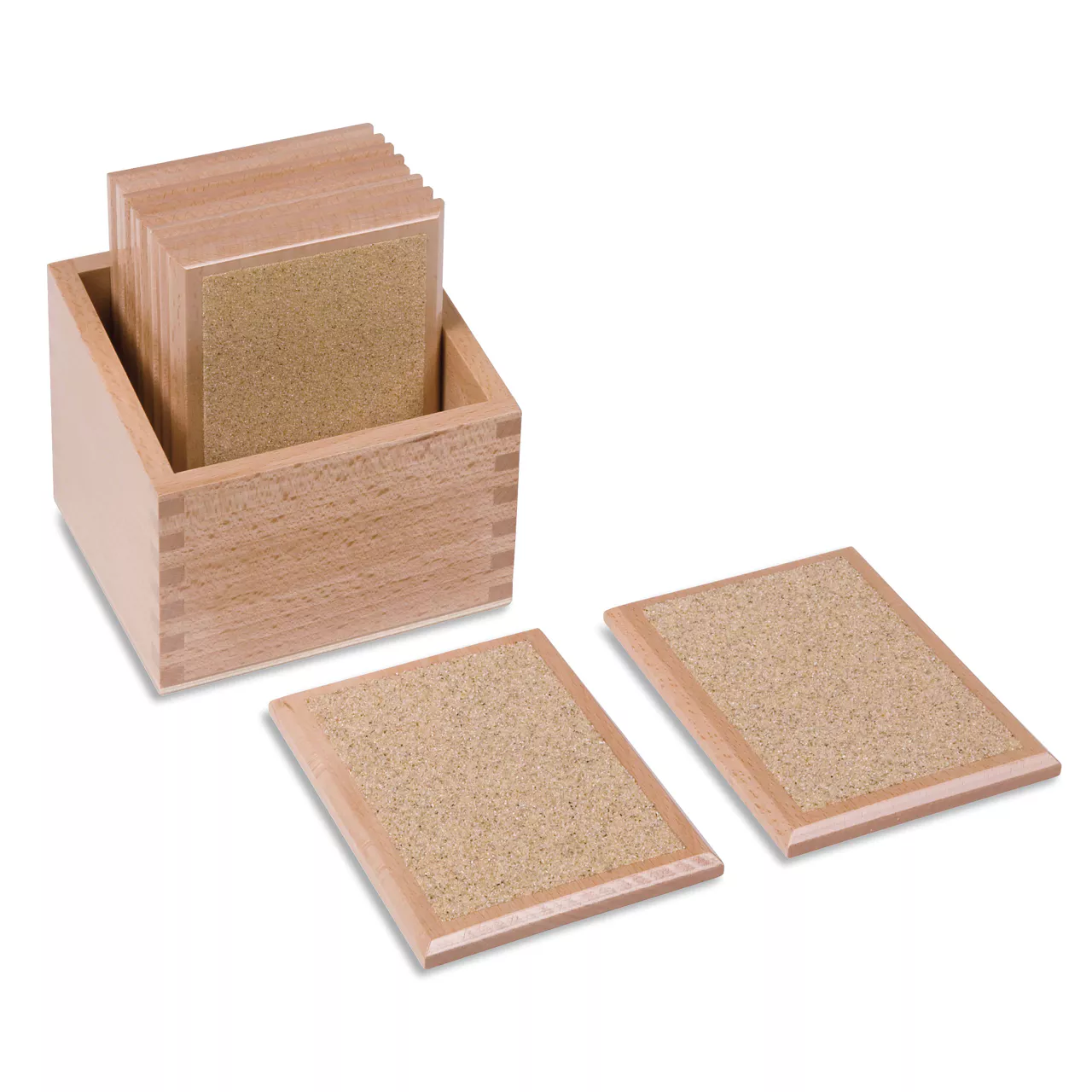
The standard Nienhuis set consists of five pairs of wooden tablets (10 tablets total), each covered with sandpaper of a different grade, representing five distinct levels of roughness. The tablets are stored in a wooden box for protection and order. Approximate tablet size: 12 × 9 cm.
-
Made of natural wood with rounded edges for safety
-
Securely attached, child-safe sandpaper surfaces
-
Child-sized tablets designed for easy handling
Classroom & Home Use
Used in the Sensorial (Tactile Sense) area on a table or mat. Children trace the surfaces using two to three fingers with gentle pressure and slow, deliberate movements. Once familiar, the activity may be done with eyes closed or with a blindfold to isolate the tactile sense.
Common extensions include: