Material name: The Bells (Montessori Bells)
Area: Sensorial (Auditory) & Music
Purpose & developmental benefits:
The Bells refine the child’s auditory sense and musical perception through listening, comparing pitch, and ordering musical notes. Each bell represents a specific pitch, allowing children to distinguish high and low sounds, develop accurate listening, and become familiar with the musical scale in a natural, sensorial way. This material forms an important bridge between the senses, music, and language.
Skills supported:
-
Discriminates and remembers pitch differences (low vs. high sounds)
-
Matches bells of the same pitch
-
Orders pitches in ascending and descending scales
-
Develops focused listening, concentration, and auditory memory
-
Refines hand–eye coordination and control when striking and damping the bells
-
Builds a foundation for music education and basic music theory: note recognition, scales, and simple melody creation
Recommended age:
3–6 years (Casa), with continued use in 6–12 years for deeper music theory and composition work
Material & design:
-
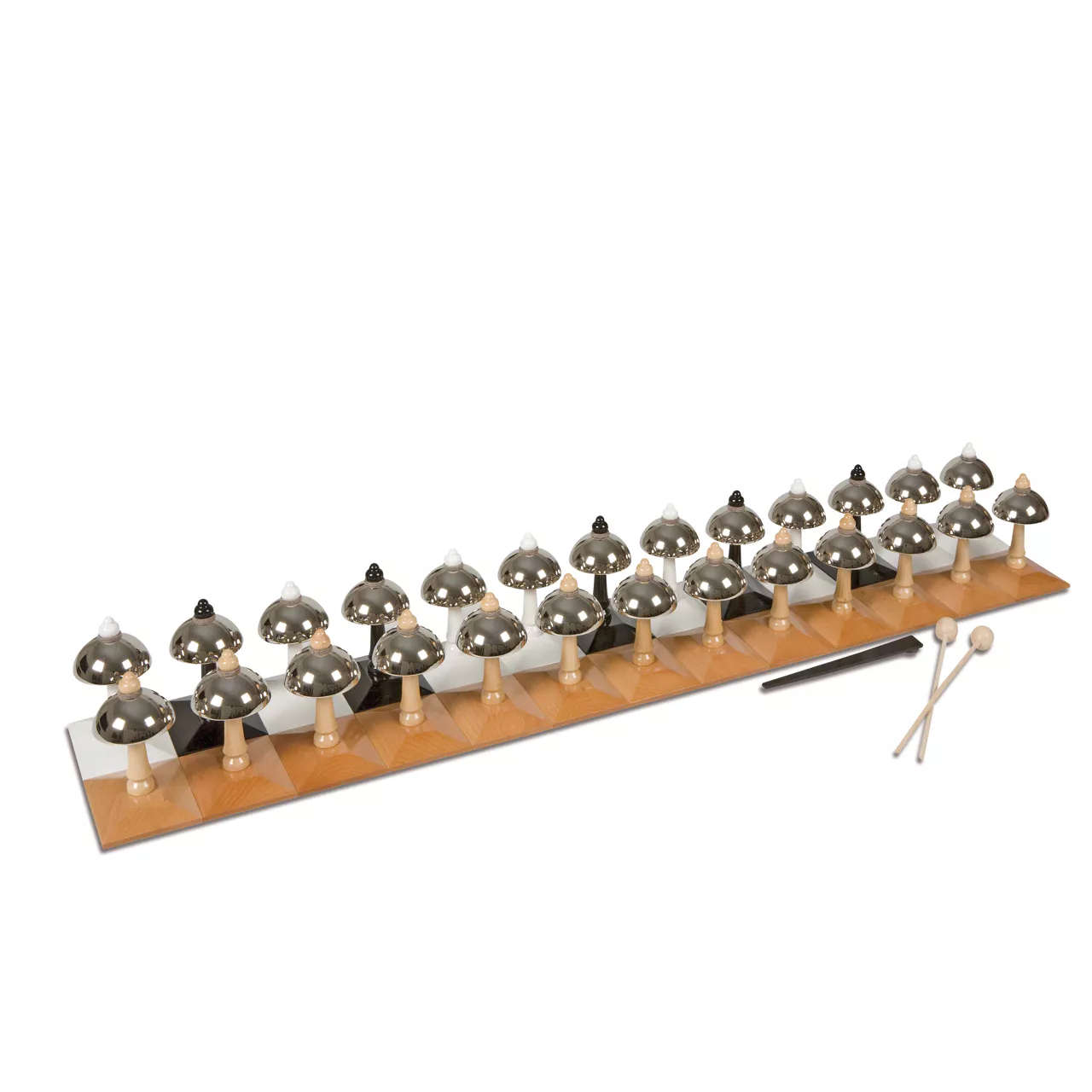
A standard Nienhuis set consisting of 13 pairs of bells (26 bells total), forming a chromatic scale starting from Middle C (Do)
-
Control set: bells mounted on black and white bases, corresponding to piano keys (black for sharps/flats, white for natural notes)
-
Working set: bells on natural or varnished wooden bases for ear-based matching
-
Includes two mallets and a damper
-
Materials: beech wood, metal, and felt
Use in the classroom / at home:
-
Children listen to and play the scale on the control set to form an auditory impression of gradation
-
Mix the working bells and match them to the control bells by pitch
-
Arrange the bells from lowest to highest pitch
-
Extensions: Three contrasting bells, creating simple melodies, recognizing intervals, and progressing toward basic musical notation
-
Requires a quiet environment and guidance in gentle striking and proper use of the damper to stop the sound after each note