Material name: Decanomial Square
(Montessori Decanomial Square – Power of 10)
Area: Mathematics (Algebra Preparation) & Sensorial
Purpose & developmental benefits:
The Decanomial Square enables children to explore algebraic structure through plane geometry by assembling squares and rectangles of varying sizes and colors into a complete “power of ten” layout. Through hands-on manipulation, children gain an indirect impression of the square of a sum of ten components, without using formulas or symbols. This material extends logical thinking, structural analysis, and provides deep preparation for later algebraic understanding.
Skills supported:
-
Arranges shapes in a systematic size gradation from small to large
-
Refines visual discrimination of square areas and corresponding rectangles
-
Accurately matches and combines rectangles with each square to form larger complete squares
-
Develops logical thinking, order, perseverance, and self-correction
-
Provides indirect preparation for algebra, including understanding the structure of (a + b + c + … + j)² and the concept of “squaring”
???? Recommended age:
Material & design:
-
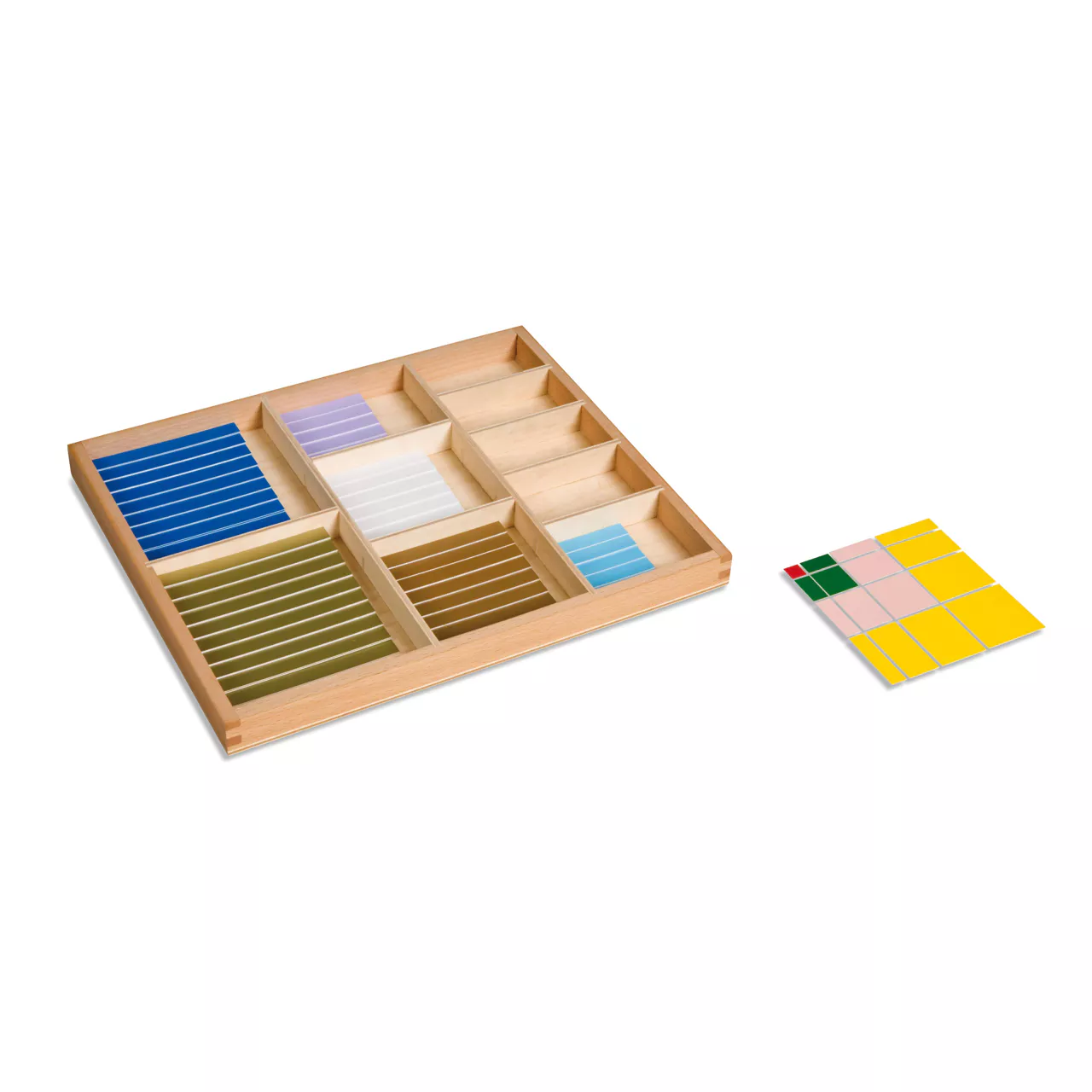
A standard Nienhuis set housed in a beechwood box divided into 10 compartments
-
Contains color-coded sets of squares and rectangles, typically made of durable plastic or wood depending on the version
-
10 squares with increasing sizes from 1×1 to 10×10
-
Each larger square is accompanied by matching rectangular pieces (e.g. the 4×4 square is paired with 4×3, 4×2, and 4×1 rectangles) that combine to form a complete larger square
-
Color scheme follows the Montessori color system / Bead Stair, helping children recognize structural patterns
Use in the classroom / at home:
Children begin by selecting sets from smallest to largest, placing the square diagonally and then adding the corresponding rectangles to “fill in” and complete a larger square. As familiarity grows, children may separate and recombine the pieces in multiple ways to observe how smaller “component squares” form the larger whole—laying the groundwork for understanding the square of a sum.
At home, it is best to work on a large mat, offering one color/level at a time to avoid overload and to support deep, focused exploration.