Material name: Graded Geometric Figures (Montessori Graded Geometric Figures)
Area: Sensorial & Geometry
Purpose & developmental benefits:
Graded Geometric Figures help children recognize and compare changes in size within the same plane geometric shape while the form remains constant. Through ordering, arranging, and close observation, children refine visual discrimination, size perception, and geometric thinking. At the same time, they develop a sense of order and variation, forming an essential foundation for later work in mathematics and geometry.
Skills supported:
-
Discriminates size along a single visual variable and orders shapes from largest to smallest
-
Develops comparison, seriation, and order
-
Recognizes concentric, inscribed, and circumscribed relationships between shapes
-
Sharpens observation of curves, edges, angles, and defining features of each shape family
-
Refines fine motor skills and precision when aligning edges and outlines
-
Prepares for elementary geometry, including equivalence, area, and relationships between plane figures
Recommended age:
Material & design:
-
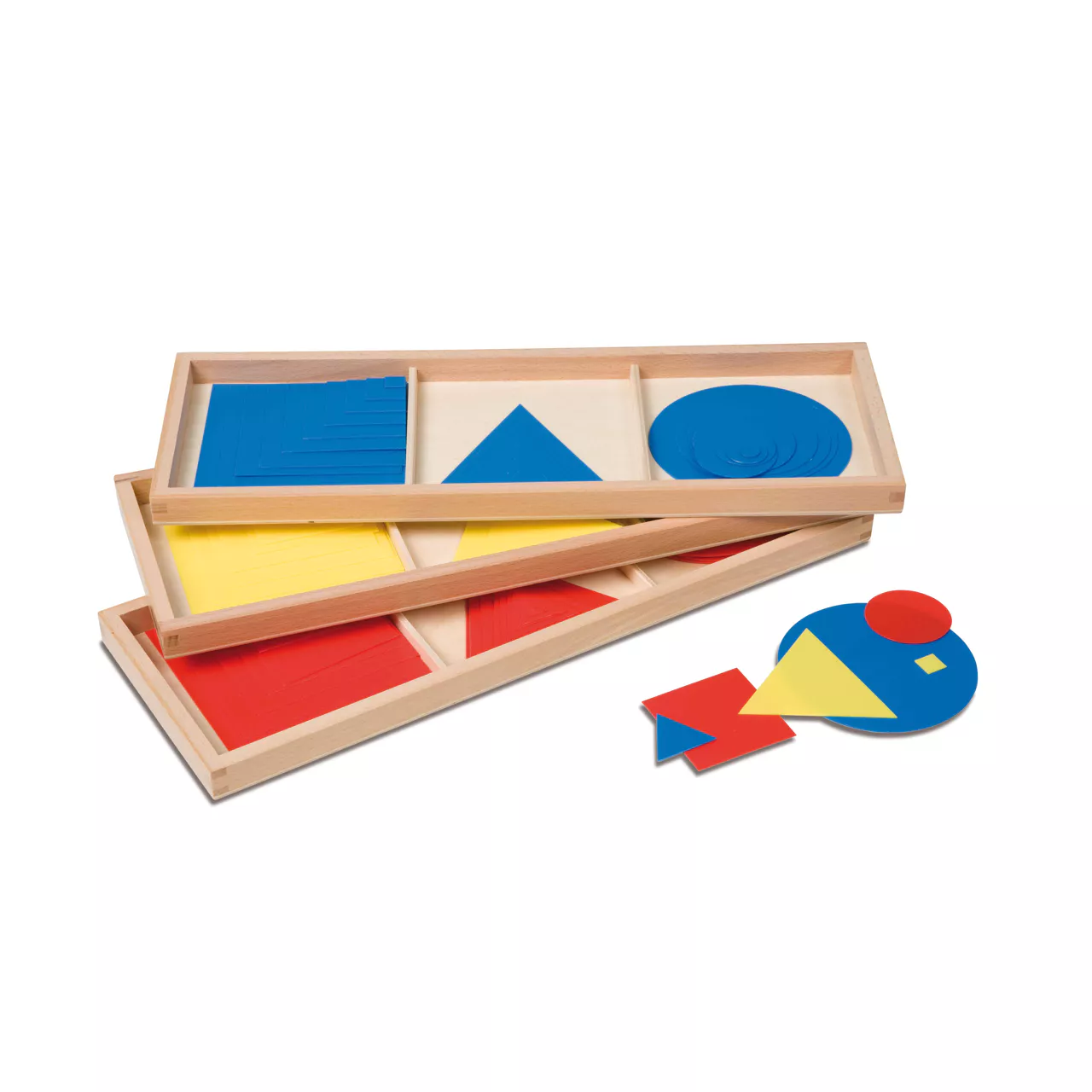
A standard set consisting of three rectangular boxes, each divided into three compartments containing similar plane figures of graduated sizes
-
10 circles per color, with diameters increasing from approximately 1 to 10 cm
-
10 squares per color, with side lengths increasing from approximately 1 to 10 cm
-
10 equilateral triangles per color, with side lengths increasing from approximately 1 to 10 cm
-
Each shape is available in three colors (red, blue, yellow/orange), allowing comparison within the same shape family or across different families
-
Some Nienhuis versions are made from durable plastic with precise cuts, suitable for concentric and inscribed/circumscribed work
-
Made of wood or sturdy board, smoothly finished
-
Standard Montessori colors, clear and easy to observe
-
Separate boxes or trays support orderly storage and independent use
Use in the classroom / at home:
Children select one compartment (e.g. blue squares), spread the shapes out, and arrange them in gradation from largest to smallest. They may then place the shapes concentrically to observe how the same form changes in size while sharing a common center.
As skill develops, children can:
-
Mix two or three colors within one shape family
-
Combine different shape families to explore inscribed and circumscribed figures
-
Create geometric patterns and designs
At home, it is best to offer one compartment at a time, with enough space to lay out long sequences or concentric arrangements comfortably.