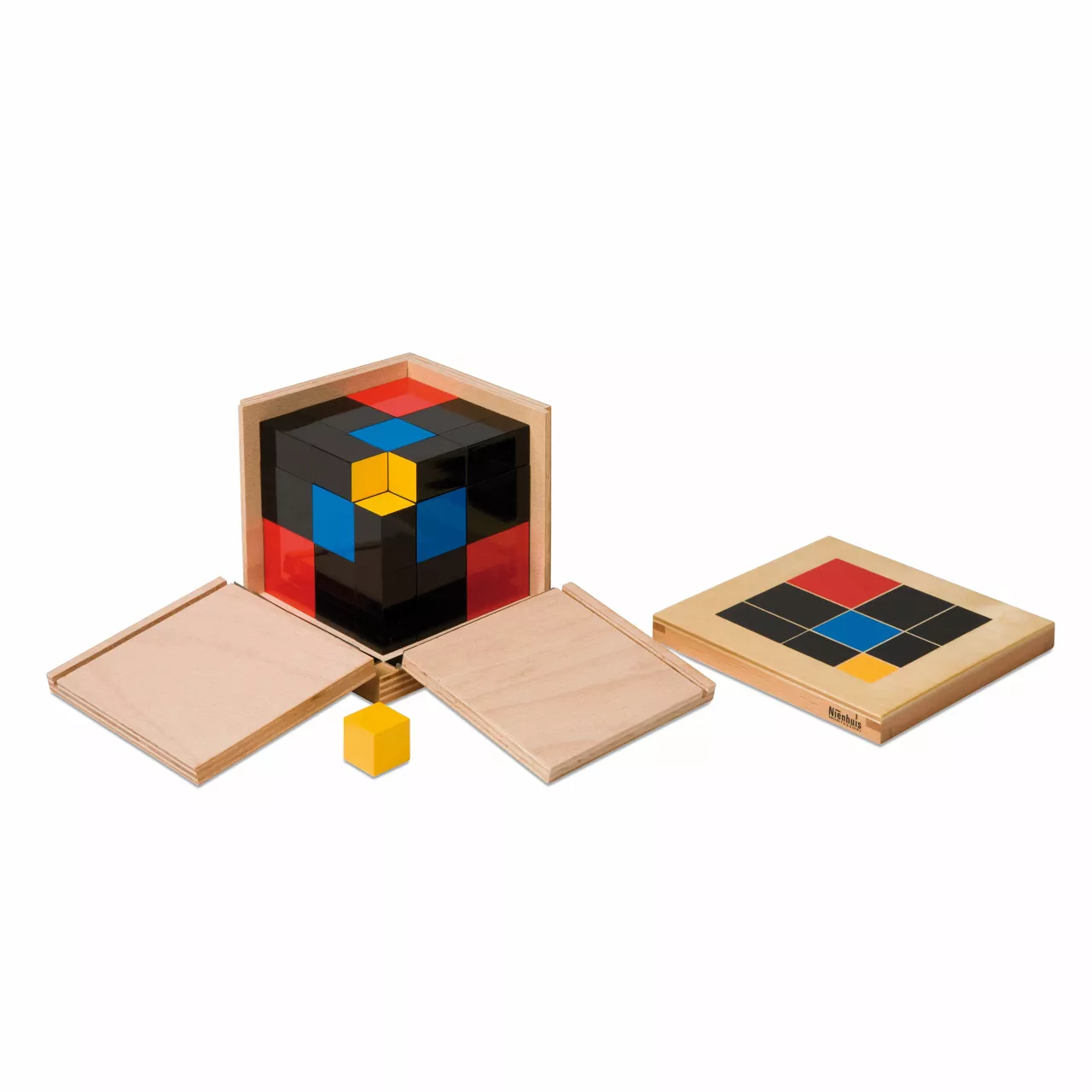
Material name: Trinomial Cube (Montessori Trinomial Cube)
Area: Sensorial & Mathematics (Algebra Preparation)
Purpose & developmental benefits:
The Trinomial Cube enables children to explore algebraic structure through three-dimensional geometry by assembling cubes and rectangular prisms into a single, complete cube. Through hands-on manipulation, children gain an indirect understanding of the structure of (a + b + c)³, without the use of formulas or symbols. As a natural progression from the Binomial Cube, this material supports the development of logical thinking, order, and more complex structural analysis.
Skills supported:
-
Constructs a three-dimensional form by following a pattern, recognizing relationships among size, shape, and color
-
Develops refined visual discrimination and spatial reasoning
-
Strengthens fine motor skills, hand–eye coordination, and precision in assembling blocks
-
Builds concentration, perseverance, and self-correction, as the cube must fit perfectly to be complete
-
Prepares for and supports elementary algebra, including recognition and proof of (a + b + c)³
Recommended age:
Material & design:
-
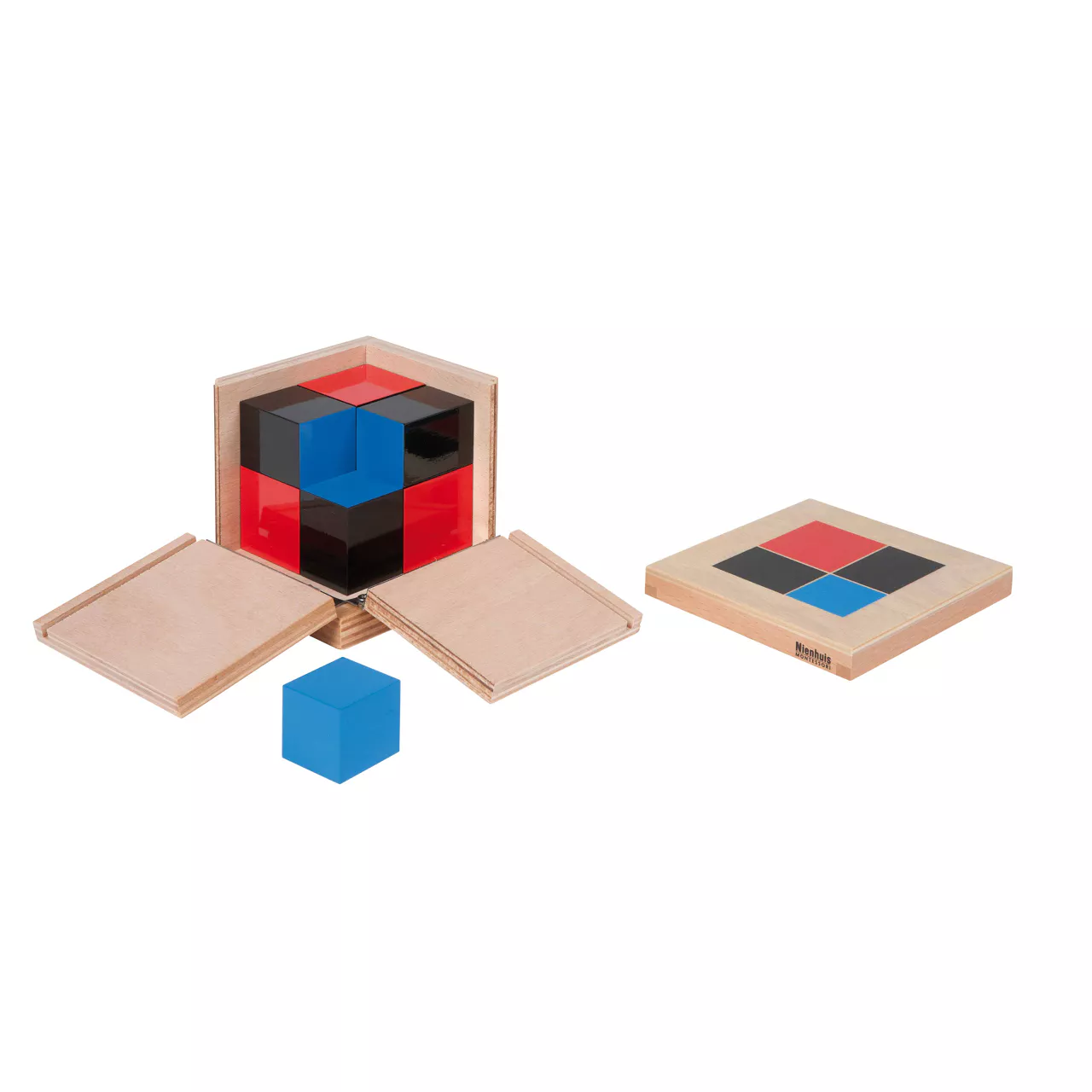
A wooden box with a hinged lid, with color-pattern guides on the lid and inner sides to support construction
-
Contains 27 wooden blocks (cubes and rectangular prisms) in varying sizes
-
Pieces assemble precisely to form a larger cube according to the trinomial structure
-
Standard Montessori colors: red, blue, yellow, and black
-
Made of natural wood, smoothly finished with rounded edges for safety
Use in the classroom / at home:
Children open the box, remove all the blocks onto a work mat, and then reconstruct the cube inside the box by following the color patterns on the lid and box sides. The material is self-correcting, as the cube will only fit correctly when assembled accurately.
At the elementary level, teachers guide children to connect each group of blocks to the terms of (a + b + c)³, compare the work with the Binomial Cube, and engage in algebraic demonstrations.
At home, the material is best offered in a quiet, unhurried environment, allowing children to experiment, make mistakes, and self-correct independently.