


Q&A CORNER WITH THE SPEAKERS | WHEN CHILDREN “DO THINGS DIFFERENTLY” FROM ADULT INSTRUCTIONS
Q&A CORNER WITH THE SPEAKERS | WHEN CHILDREN “DO THINGS DIFFERENTLY” FROM ADULT INSTRUCTIONS
During Theme 1 of the Conference, a parent shared a very familiar situation at home:
“My 21-month-old is working with a number puzzle board. The child can only fit the pieces when the board is turned upside down; when I turn it the ‘right’ way, the child refuses. How should we respond in this situation?”
From Julia Hilson’s reflections, we can look at this situation more clearly through several perspectives:
1. Observe before intervening – rooted in the core Montessori philosophy
With a 21-month-old child, the first step is not to conclude “the child is doing it wrong,” but to pause, observe, and ask:
“Do I really need to stop this action?”
The next questions are:
-
Is this action harmful to the child?
-
Does it damage the material?
If the answer is no, adults need to be very cautious about intervening, because the child may simply be exploring in their own way.
This approach closely reflects the Montessori spirit expressed in The Child in the Family and The 1946 London Lectures:
adults are observers and preparers of the environment, stepping in only when a behavior is unsafe or disrupts the environment, not automatically correcting whenever a child does something differently from adult expectations.
2. “Doing differently” does not mean “doing wrong” – the child is building from within
Julia Hilson emphasized that there is no need to rush to correct the child’s way of turning the number board. Instead, we can understand this as part of the child’s exploratory process, which aligns closely with Montessori’s description of the absorbent mind.
In The Absorbent Mind, Maria Montessori explains that young children absorb their environment unconsciously yet profoundly — through movement, the senses, and repetition, not merely through verbal explanations.
The Secret of Childhood adds further depth by describing early life as a spiritual embryo, in which the child grows not only physically, but also allows personality and intelligence to germinate through actions that may seem very small or insignificant to adults.
When a child turns, flips, experiments, or works differently from adult demonstrations, the child is testing, perhaps not succeeding yet, then trying again in their own way. This is a natural part of building inner order.
Seen from this perspective, allowing a child to do things differently is not neglect — it is respecting the child’s deep learning mechanisms.
3. Activities must be “within reach” – aligned with the child’s developmental stage
After observing and allowing space for exploration, adults should reflect:
Is this activity truly appropriate for the child’s current developmental stage? Is the child ready for it?
If the child can engage at some level, shows interest, and wants to repeat the activity, it is likely close to their present abilities.
However, if the child consistently resists, struggles, or cannot manipulate the material even with support, the activity may be too difficult or not developmentally appropriate.
In such cases, as Julia suggests, it may be better to put the activity away temporarily and replace it with something more meaningful for the child’s development at that moment.
This perspective aligns closely with Education for Human Development by Mario Montessori Jr. and The Absorbent Mind:
each developmental stage has its own sensitive periods and needs. Activities that match these needs invite deep concentration and natural repetition, while those introduced too early or that are too challenging may lead to stress and disengagement.
4. Less but meaningful – a prepared environment with a limited number of activities
Finally, Julia shared that in the home environment, it is best not to offer too many activities at once. Ideally, parents should prepare about 4–5 activities, with a maximum of 6.
Once a child becomes familiar with and can use an activity, one new activity may be introduced into this group of 4–6, while removing those the child does not truly engage with — especially activities that are too challenging or not age-appropriate.
Julia noted that this is a point she and Kavya fully agree on. This idea strongly reflects the Montessori concept of the prepared environment within the family, as described by E.M. Standing in Montessori: Her Life & Work and by Maria Montessori in The Child in the Family:
the child’s environment should be carefully selected, simple, clear, and predictable, making it easier for the child to observe, choose, repeat activities, and gradually develop inner order.
In essence, we begin by observing what the child is exploring and only step in when the action is unsafe or may damage the material. With very young children, the adult presents the activity once, then steps back to allow the child to explore freely. At the same time, we keep reflecting on whether the activity is truly developmentally appropriate for the child right now. At home, it helps to offer a limited, meaningful set of activities—fewer but well-chosen—so the child can focus, repeat, and engage with experiences that match their current developmental needs.
References:
The Absorbent Mind; The Secret of Childhood; The Child in the Family;
Education for Human Development (Mario Montessori Jr.);
Montessori: Her Life & Work (E.M. Standing); The 1946 London Lectures.
.PNG)
.png)
.png)
.png)

Others
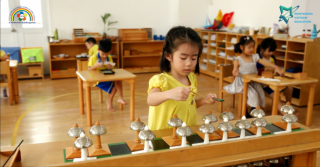
Q&A CORNER WITH THE SPEAKERS | THE MONTESSORI 3–6 ENVIRONMENT: WHERE CHILDREN “GROW BY BECOMING THEMSELVES”
“When children transition from a 0–3 environment to a 3–6 environment, what are the key differences in the physical setting?”

Q&A WITH THE SPEAKERS | A Sharing About Children: The Adult Environment – The Foundational Ground in the First Three Years of Life
When parents are busy with work, living far from extended family, or when multigenerational households hold different views… how can we prepare a truly harmonious adult environment for children aged 0–3?”

The Journey of Montessori Vietnam Education (MVEC): Sowing Seeds of Knowledge, Spreading Love (2013-2019)
As the year 2020 begins, we at Montessori Vietnam Education (MVEC) proudly reflect on our journey from 2013 to 2019—a path filled with unwavering efforts, determined steps, and a profound belief in the mission of building a humanistic education system where...

Congratulations to the Graduates of the AMI Montessori Assistant Course for the 0-3 Age Group – Ho Chi Minh City
On July 28, 2022, the heartfelt learning journey of the AMI Montessori Assistant Course for the 0-3 age group officially concluded after more than two weeks of continuous dedication and learning. This event, organized through the committed collaboration of...

Opening Ceremony of the AMI Montessori Teacher Training Course for the 0-3 Age Group: Spreading the Philosophy of Humanistic Education
On March 2, 2023, Montessori Vietnam Education (MVEC – TFMS – AMI – MTCNE) officially launched the AMI Montessori Teacher Training Course for the 0-3 age group. The ceremony, conducted online via Zoom, marked a significant milestone in the advancement...

Lastest posts
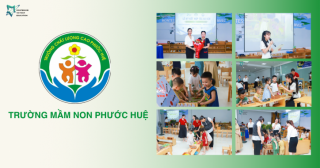
COOPERATION SIGNING CEREMONY: MVEC – TFM – PHƯỚC HUỆ PRESCHOOL
Together, we create stronger partnerships, nurture brighter futures, and inspire meaningful change. We are delighted to share a memorable milestone in our journey of educational collaboration as MVEC, Tiny Flower Montessori (TFM), and Phước Huệ...

MONTESSORI AMI 3–6 PROFESSIONAL DEVELOPMENT COURSE | AUGUST 2026
Every Montessori journey is a journey of continuous learning — a journey of observing, reflecting, and growing alongside the child. This August, MVEC was delighted to welcome teachers and educators back to another meaningful chapter of learning through...

DR. SILVIA C. DUBOVOY
As an AMI trainer, examiner, consultant, researcher, and long-serving leader within the Association Montessori Internationale, she brings participants a unique combination of academic excellence, practical experience, and deep humanistic insight. MVEC is...

MS. GRETCHEN HALL
With extensive experience as an educator, school leader, consultant, and AMI leader, she brings participants a wealth of practical expertise, academic excellence, and a strong commitment to authentic Montessori education. MVEC is honored to introduce Ms....

MS. TANIA STEWART
Exceptional Montessori educators are shaped by deep classroom experience, professional expertise, and a lifelong commitment to supporting children’s development. MVEC is honored to introduce Ms. Tania Stewart, an AMI 3–6 Teacher Trainer whose passion,...

MS. COURTNEY A. REIM
Strong Montessori communities are built through effective leadership, thoughtful management, and a shared commitment to educational excellence. MVEC is honored to introduce Ms. Courtney A. Reim, Executive Director of Montessori Training Center Northeast...
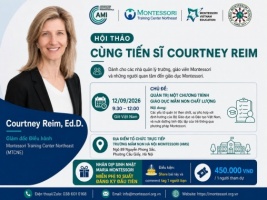
CONVERSATION WITH DR. COURTNEY REIM, Ed.D. | HANOI – SEPTEMBER 12, 2026
Quality education begins with thoughtful leadership, a clear vision, and a deep understanding of what children truly need to thrive. This September, MVEC is delighted to bring together educators and school leaders in Hanoi for a meaningful conversation on...

MS. KAVYA CHANDRASEKHAR
With comprehensive AMI qualifications spanning all four developmental levels from birth to 18 years, combined with extensive leadership experience in Montessori education, she brings participants a broad, practical, and internationally informed perspective....

MS. DIWO LHAMO PEMBA
With extensive experience leading AMI teacher education programs across multiple continents and pioneering Montessori training initiatives in emerging regions, she brings participants a wealth of international expertise, practical insight, and deep commitment...