


Q&A CORNER WITH THE SPEAKERS | THE MONTESSORI 3–6 ENVIRONMENT: WHERE CHILDREN “GROW BY BECOMING THEMSELVES”
Q&A CORNER WITH THE SPEAKERS | THE MONTESSORI 3–6 ENVIRONMENT: WHERE CHILDREN “GROW BY BECOMING THEMSELVES”
During Theme 1: The Importance of the Prepared Environment in the First Three Years of Life (Montessori Vietnam Conference Series 2025–2026), a 3–6 Montessori teacher raised the following question:
“When children transition from a 0–3 environment to a 3–6 environment, what are the key differences in the physical setting?”
Each Montessori environment is prepared not to be visually attractive, but to respond precisely to the developmental needs of each stage. Therefore, the difference between 0–3 and 3–6 lies not in the number of materials, but in the fundamentally different developmental needs of the child.
The 0–3 environment: security, movement, and belonging
At the 0–3 stage, children need an environment that is:
-
Simple, safe, warm, and predictable
-
Equipped with low, light, easy-to-handle materials — just enough
What matters is not having many materials, but creating a space that supports free movement, early steps toward self-care, and a secure emotional bond with adults.
Living in such an environment, children gradually develop the inner feelings:
-
“I belong in this world.”
-
“I can do things by myself.”
This is the very foundation Maria Montessori described when speaking of the absorbent mind in The Absorbent Mind.
The 3–6 environment: conscious work, order, and independence
When children enter the 3–6 stage, the absorbent mind becomes more conscious (Education for Human Development). Children now seek:
-
Order
-
Understanding of cause and effect
-
Opportunities to cooperate
-
A sense of self through meaningful work
As E.M. Standing describes in Montessori: Her Life & Work, the 3–6 environment is therefore prepared with:
-
A richer range of materials
-
Clearly defined areas (Practical Life, Sensorial, Language, Mathematics, Culture)
-
Materials arranged in developmental sequences
This allows children to freely choose their work and engage independently within a structured framework.
Each daily classroom experience — from unrolling a work mat, choosing an activity, to repeating it patiently until mastery — is not merely about “finishing a task.” It is a daily process through which children develop intellect, character, and perseverance.
Observation builds the bridge between 0–3 and 3–6
Speaker Julia Hilson also shared that to truly understand the 0–3 environment, adults should not rely solely on written standards, but must observe real classrooms in action.
When we deeply understand and observe both stages — 0–3 and 3–6, a natural bridge of transition is formed. Children then enter the 3–6 environment with inner confidence and calm, rather than simply “moving up to the next class.”
For parents who wish to better understand the differences and standards of Montessori environments for ages 0–3 and 3–6, MVEC warmly welcomes you to observe directly at the Center.
As Julia Hilson shared:
“In some centers I know, Montessori Vietnam Education Center (MVEC) has a well-prepared environment for children of this age. If we are able to request permission to observe while children are working, it becomes the most practical and meaningful learning experience.”
Every corner of the classroom, every material, every quiet moment of a child reminds us that:
Montessori is not just a teaching method — it is a way of respecting the child so they can become fully themselves.
We look forward to seeing you at Theme 2: What Parents Need to Know About Children – The 3–6 Stage
with Diwo Lhamo Pemba (AMI 3–6 Trainer),
morning of December 21, 2025.
The webinar is free of charge: Link
References:
The Absorbent Mind; The Secret of Childhood; The Child in the Family;
Education for Human Development (Mario Montessori Jr.);
Montessori: Her Life & Work (E.M. Standing); The 1946 London Lectures.
.png)

Others
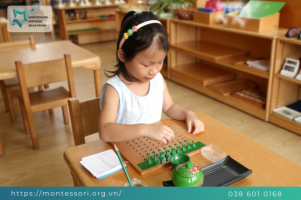
Q&A CORNER WITH THE SPEAKERS | WHEN CHILDREN “DO THINGS DIFFERENTLY” FROM ADULT INSTRUCTIONS
“My 21-month-old is working with a number puzzle board. The child can only fit the pieces when the board is turned upside down; when I turn it the ‘right’ way, the child refuses. How should we respond in this situation?”

Q&A WITH THE SPEAKERS | A Sharing About Children: The Adult Environment – The Foundational Ground in the First Three Years of Life
When parents are busy with work, living far from extended family, or when multigenerational households hold different views… how can we prepare a truly harmonious adult environment for children aged 0–3?”

The Journey of Montessori Vietnam Education (MVEC): Sowing Seeds of Knowledge, Spreading Love (2013-2019)
As the year 2020 begins, we at Montessori Vietnam Education (MVEC) proudly reflect on our journey from 2013 to 2019—a path filled with unwavering efforts, determined steps, and a profound belief in the mission of building a humanistic education system where...

Congratulations to the Graduates of the AMI Montessori Assistant Course for the 0-3 Age Group – Ho Chi Minh City
On July 28, 2022, the heartfelt learning journey of the AMI Montessori Assistant Course for the 0-3 age group officially concluded after more than two weeks of continuous dedication and learning. This event, organized through the committed collaboration of...

Opening Ceremony of the AMI Montessori Teacher Training Course for the 0-3 Age Group: Spreading the Philosophy of Humanistic Education
On March 2, 2023, Montessori Vietnam Education (MVEC – TFMS – AMI – MTCNE) officially launched the AMI Montessori Teacher Training Course for the 0-3 age group. The ceremony, conducted online via Zoom, marked a significant milestone in the advancement...

Lastest posts
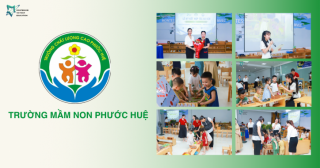
COOPERATION SIGNING CEREMONY: MVEC – TFM – PHƯỚC HUỆ PRESCHOOL
Together, we create stronger partnerships, nurture brighter futures, and inspire meaningful change. We are delighted to share a memorable milestone in our journey of educational collaboration as MVEC, Tiny Flower Montessori (TFM), and Phước Huệ...
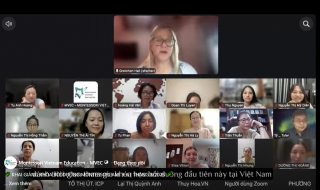
MONTESSORI AMI 3–6 PROFESSIONAL DEVELOPMENT COURSE | AUGUST 2026
Every Montessori journey is a journey of continuous learning — a journey of observing, reflecting, and growing alongside the child. This August, MVEC was delighted to welcome teachers and educators back to another meaningful chapter of learning through...

DR. SILVIA C. DUBOVOY
As an AMI trainer, examiner, consultant, researcher, and long-serving leader within the Association Montessori Internationale, she brings participants a unique combination of academic excellence, practical experience, and deep humanistic insight. MVEC is...

MS. GRETCHEN HALL
With extensive experience as an educator, school leader, consultant, and AMI leader, she brings participants a wealth of practical expertise, academic excellence, and a strong commitment to authentic Montessori education. MVEC is honored to introduce Ms....

MS. TANIA STEWART
Exceptional Montessori educators are shaped by deep classroom experience, professional expertise, and a lifelong commitment to supporting children’s development. MVEC is honored to introduce Ms. Tania Stewart, an AMI 3–6 Teacher Trainer whose passion,...

MS. COURTNEY A. REIM
Strong Montessori communities are built through effective leadership, thoughtful management, and a shared commitment to educational excellence. MVEC is honored to introduce Ms. Courtney A. Reim, Executive Director of Montessori Training Center Northeast...
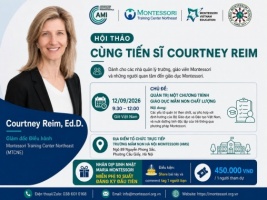
CONVERSATION WITH DR. COURTNEY REIM, Ed.D. | HANOI – SEPTEMBER 12, 2026
Quality education begins with thoughtful leadership, a clear vision, and a deep understanding of what children truly need to thrive. This September, MVEC is delighted to bring together educators and school leaders in Hanoi for a meaningful conversation on...

MS. KAVYA CHANDRASEKHAR
With comprehensive AMI qualifications spanning all four developmental levels from birth to 18 years, combined with extensive leadership experience in Montessori education, she brings participants a broad, practical, and internationally informed perspective....

MS. DIWO LHAMO PEMBA
With extensive experience leading AMI teacher education programs across multiple continents and pioneering Montessori training initiatives in emerging regions, she brings participants a wealth of international expertise, practical insight, and deep commitment...